International buyers sourcing bulk psyllium husk from India may encounter different types of companies during supplier research. Some describe themselves as exporters, some as suppliers, some as processors, and others as manufacturers.
These terms can overlap, but the underlying business model can be different. For a buyer, understanding who actually handles the product can make supplier qualification easier and help set realistic expectations about quality control, customization, traceability and order management.
The important question is not simply whether a company calls itself a manufacturer or supplier. The important question is whether it can reliably meet the buyer's required specification, quantity, quality controls, documentation and delivery requirements.
Supplier vs. Manufacturer: What Is the Difference?
There is no universal rule that one business model is automatically suitable for every buyer. The appropriate choice depends on the buyer's requirements.
Why the Distinction Matters for Psyllium Husk
Psyllium husk is a processed agricultural ingredient, so the route from raw material to export-ready product can involve multiple stages.
Depending on the supplier's business model, these stages may include sourcing, cleaning, processing, grading, quality inspection, packaging and export coordination.
For a buyer with strict specifications, understanding where these activities take place can help create a clearer quality and traceability discussion.
What Does a Psyllium Husk Supplier Do?
A supplier typically focuses on providing the product requested by the buyer. The supplier may source material from one or more processing facilities or manufacturing partners and coordinate the final commercial supply.
This model can provide flexibility, particularly when a buyer needs different grades, quantities or packaging options.
However, buyers should understand the supplier's sourcing network and quality-control process before assuming that the supplier directly processes every kilogram it sells.
What Does a Psyllium Husk Manufacturer or Processor Do?
A processor or manufacturer performs physical processing activities that convert or prepare the raw agricultural material into the required product.
For psyllium, processing can involve operations associated with cleaning, separation, grading and preparation of the finished ingredient, depending on the facility and product specification.
Buyers evaluating a processing operation should focus on the actual capabilities and controls rather than relying only on the word “manufacturer” in a company profile.
Does Buying Directly From a Manufacturer Always Mean Better Quality?
Not necessarily.
Direct access to a processing facility can provide useful visibility into production and quality-control activities, but product quality ultimately depends on the specification, raw-material management, processing controls, testing and consistency of the supplied batches.
A capable exporter or supplier with an established and controlled processing network can also provide a reliable commercial supply.
For this reason, buyers should evaluate evidence of capability rather than making the supplier's business label the deciding factor.
When a Direct Manufacturer Relationship May Be Useful
A direct relationship with a processor may be useful when the buyer requires:
- Large recurring volumes
- Detailed technical specifications
- Customized processing requirements
- Specific packaging arrangements
- Regular batch-level quality information
- Closer visibility into processing operations
The buyer should still establish whether the facility can consistently meet the required export and destination-market requirements.
When a Supplier or Exporter Can Be Practical
A supplier or exporter can be useful when the buyer wants:
- A single commercial contact
- Flexible sourcing options
- Different product grades
- Export documentation coordination
- Shipment and logistics coordination
- Packaging flexibility
- Support with recurring international orders
For some buyers, this can simplify procurement because the exporter coordinates several parts of the supply chain.
Start With the Product Specification
Regardless of the supplier model, the buyer should define the required psyllium specification before comparing companies.
Relevant parameters can include purity, moisture, swelling performance, mesh size, appearance, microbiological requirements and other application-specific criteria.
Read Psyllium Husk Specifications: Purity, Moisture, Swelling Index and Mesh Explained for a detailed overview of key purchasing parameters.
Ask Who Actually Processes the Product
One of the simplest supplier-qualification questions is:
“Who processes the psyllium husk supplied under this quotation?”
The answer can help the buyer understand the supply chain.
If the exporter works with a separate processor, the buyer can then ask how quality is controlled between processing, packaging and export.
Ask About Quality Control
Buyers should understand how the supplier verifies that the finished product meets the agreed specification.
Questions can include:
- Which parameters are tested?
- When is testing performed?
- Is testing performed for individual batches?
- Can a batch-specific Certificate of Analysis be provided?
- How are non-conforming batches handled?
- How is the approved specification communicated to the processing team?
The answers are more useful than the company label alone.
Ask About Traceability
Traceability becomes increasingly important as order volumes grow.
A buyer should be able to understand how the finished shipment is connected to identifiable product or batch information and its quality documentation.
This becomes particularly useful when a buyer operates multiple inventory lots or needs to investigate a quality issue.
For a deeper discussion of traceability, Psyllium Husk Quality and Purity Standards Explained for Buyers.
Compare Packaging Capability
The buyer should establish whether the supplier can provide the required packaging consistently.
Questions may include:
- What bulk pack sizes are available?
- What packaging materials are used?
- Are inner liners available where required?
- Can packaging be customized?
- Can labels be prepared according to the buyer's requirements?
- How is packaging checked before dispatch?
Packaging requirements should be agreed before the commercial order is finalized.
Compare Minimum Order Quantities
A direct processing facility may have different commercial requirements from a trading supplier.
Minimum order quantities can depend on production planning, packaging format, customization and shipment economics.
Buyers should therefore ask for the actual minimum order quantity for the specification they require rather than assuming that every product grade has the same MOQ.
Consider Supply Continuity
For a long-term buyer, the ability to supply one successful shipment is only one part of supplier evaluation.
The buyer should consider whether the supplier has a repeatable procurement and processing system capable of supporting future orders.
Discuss expected shipment frequency, estimated annual volume, lead times and the process for maintaining the agreed specification across subsequent orders.
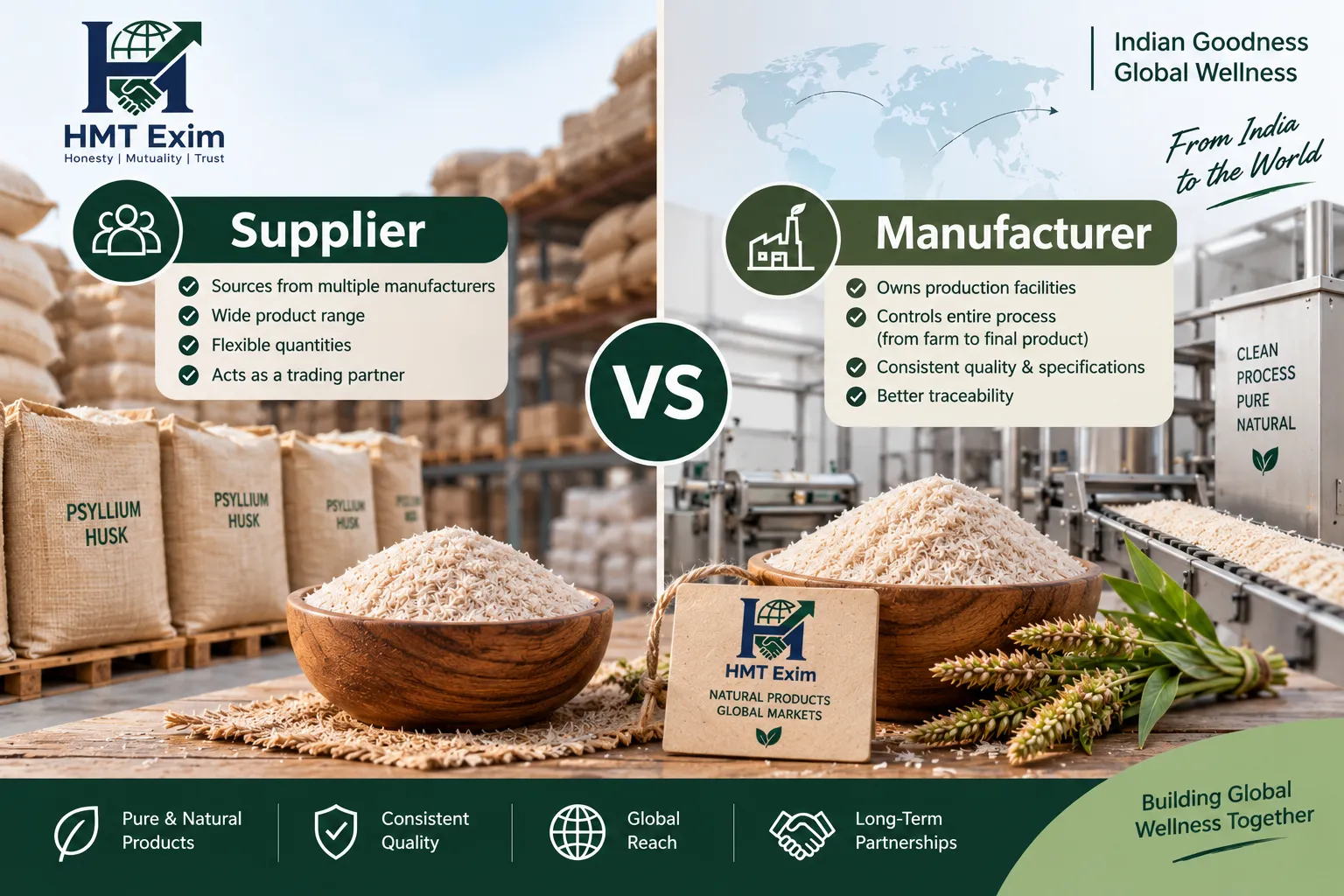
Supplier vs. Manufacturer: A Practical Comparison
This is a general comparison. Individual companies can operate very differently, so buyers should verify the actual operating model of the company they are evaluating.
Questions to Ask Before Choosing a Supplier
- Are you the processor, manufacturer, supplier or exporter?
- Where is the psyllium processed?
- Who controls the raw-material sourcing?
- What specifications can you consistently supply?
- Which quality parameters are tested?
- Can you provide a representative sample?
- Can you provide batch-level quality documentation?
- How is batch traceability maintained?
- What packaging options are available?
- What quantities can you supply regularly?
- What is the expected lead time?
- Which export documents are provided?
- Which Incoterms and payment terms are available?
Why Sample Approval Still Matters
Even when a buyer chooses to work directly with a manufacturer, a sample should still be evaluated against the agreed specification.
The sample provides a practical reference for the commercial order and can help identify differences between the buyer's expectations and the proposed product.
For recurring purchases, the approved specification should remain documented so future shipments can be evaluated consistently.
Do Not Confuse “Manufacturer” With “Guaranteed Supply”
A processing facility can have strong capabilities without being the right commercial partner for every buyer.
Likewise, an exporter that coordinates supply through qualified processors can provide an efficient sourcing solution.
The relevant question is whether the complete supply chain can meet the buyer's requirements consistently.
How HMT Exim Fits Into the Supply Chain
HMT Exim works with international B2B buyers sourcing Indian agricultural and food ingredients and coordinates product, quality, packaging and export requirements according to the transaction.
For psyllium husk enquiries, buyers can provide their required specification, quantity, packaging and destination so the sourcing discussion can be structured around the actual application.
To discuss a bulk psyllium requirement, contact HMT Exim.
Frequently Asked Questions
Is a psyllium supplier the same as a manufacturer?
No. A supplier may source and provide psyllium while a manufacturer or processor performs physical processing activities. However, one company can perform multiple roles.
Should international buyers always buy directly from a manufacturer?
Not necessarily. The appropriate model depends on the buyer's required volume, specifications, customization, documentation and preferred supply-chain structure.
How can I verify whether a psyllium exporter is actually a manufacturer?
Ask where the product is processed, which activities are performed in-house, what facility handles the product and how quality and batch traceability are controlled.
What is more important than the supplier's business label?
The actual capability to consistently meet the agreed product specification, quality requirements, packaging, documentation and delivery expectations.
Should I request a sample from a manufacturer?
Yes. Sample approval can help confirm that the proposed product meets the buyer's specification before a commercial bulk order.
Final Takeaway
For international psyllium buyers, the choice between a supplier, exporter and manufacturer should be based on the actual requirements of the procurement program rather than the company label alone.
Understand who processes the product, how quality is controlled, how traceability works, what quantities can be supplied and how export documentation is handled.
A transparent supply chain and clearly defined specification can provide a stronger foundation for repeat international procurement.
If you are sourcing bulk psyllium husk from India, contact HMT Exim with your required specification, quantity and destination.