Exporting turmeric from India involves more than arranging the product and shipping it overseas. The exporter must prepare commercial documents, complete applicable regulatory requirements and ensure that the shipment information is consistent across the export documentation.
For international buyers, understanding the documentation process is equally useful because accurate documents support customs clearance, payment processing, shipment tracking and import compliance at the destination.
This guide explains the main documentation and compliance areas that exporters and buyers should review when preparing a turmeric shipment from India.
Why Documentation Matters in Turmeric Exports
Export documentation creates the official record of a commercial shipment. Product description, quantity, value, buyer and seller information, origin and shipping details need to be presented consistently across the relevant documents.
Errors such as inconsistent quantities, incorrect product descriptions or mismatched shipment information can create avoidable delays during document processing or customs clearance.
Key Documents for a Turmeric Export Shipment
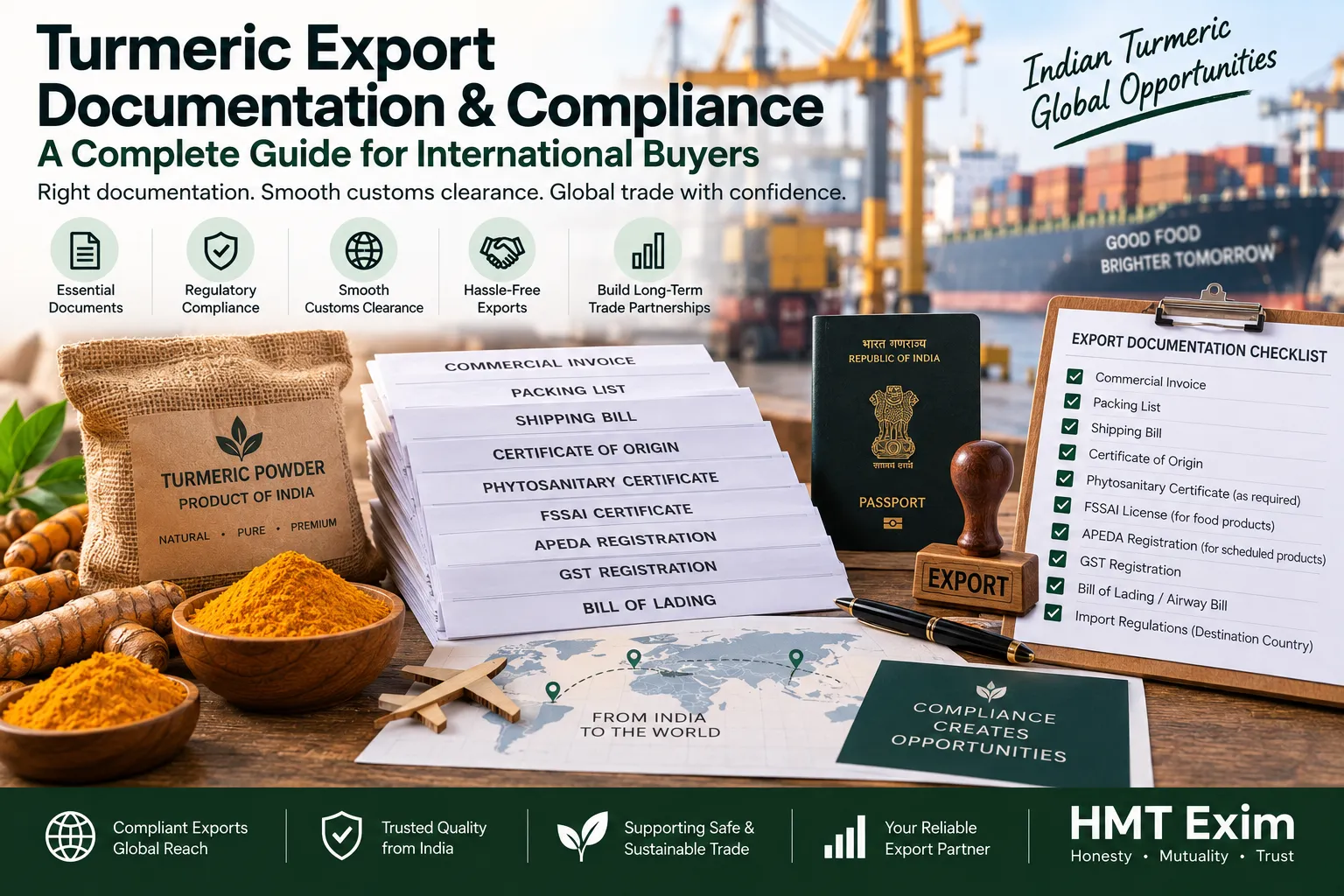
The exact document set depends on the transaction, destination country, product form and applicable regulations. Common export documents can include:
- Import Export Code (IEC)
- Commercial invoice
- Packing list
- Shipping bill
- Bill of lading or other applicable transport document
- Certificate of origin where required
- Certificate of Analysis or laboratory documentation where applicable
- Phytosanitary certificate where applicable
- Insurance documentation where applicable
- Other certificates or declarations required by the destination market
Exporters should determine the exact requirements for the specific shipment instead of assuming that every destination requires the same documents.
Import Export Code (IEC)
The IEC is an important registration for Indian businesses undertaking import or export activities.
Before exporting, the exporter should ensure that the IEC details are valid and that the business information used for the shipment corresponds with the applicable registration records.
For a broader explanation, see What Is IEC? Complete Import Export Code Guide for Indian Exporters.
Commercial Invoice
The commercial invoice records the commercial details of the transaction between the exporter and importer.
Depending on the transaction, it generally contains information such as:
- Exporter and buyer details
- Invoice number and date
- Product description
- Quantity
- Unit price and total value
- Currency
- Applicable trade terms
- Country of origin information where required
The invoice should accurately reflect the agreed commercial transaction and remain consistent with the other shipment documents.
Packing List
The packing list provides physical shipment information and helps parties involved in handling and customs clearance understand how the goods are packed.
For turmeric shipments, the packing list may include the number of packages, net weight, gross weight, product description and other relevant packing details.
Packaging details should correspond with the actual shipment. Any agreed buyer-specific packing requirements should be finalized before the shipment is prepared.
Shipping Bill
The shipping bill is an important customs document used for export clearance from India.
The information submitted for customs clearance should accurately represent the goods being exported and the commercial transaction. Exporters should work with their customs broker or logistics provider where professional filing assistance is required.
Bill of Lading
For sea shipments, the bill of lading is a key transport document issued in connection with the carriage of goods.
It contains shipment and transportation information and may also be important for document presentation under the agreed payment terms.
Buyers and exporters should carefully check the consignee, notify-party information, ports, package details and other relevant fields before final issuance.
Certificate of Origin
A certificate of origin identifies the country of origin of the exported goods where such documentation is required.
Whether a certificate is required and which issuing process applies can depend on the destination country, trade arrangement and buyer or customs requirements.
Exporters should confirm the destination-specific requirement before shipment rather than treating a certificate of origin as universally mandatory for every transaction.
Certificate of Analysis and Product Testing
International food-ingredient buyers may request laboratory documentation to verify agreed product specifications.
Depending on the buyer's requirements, testing may cover parameters relevant to turmeric such as curcumin content, moisture, microbiological characteristics, heavy metals, pesticide residues or other agreed specifications.
The exact testing panel should be based on the product specification and destination-market requirements. A Certificate of Analysis should represent the applicable batch or sample and should not be treated as a substitute for all regulatory documentation.
Phytosanitary Certificate
Plant products can be subject to phytosanitary requirements depending on the product form and destination country.
Whether a phytosanitary certificate is required for a particular turmeric shipment should therefore be checked against the destination country's current import conditions and the nature of the commodity.
Exporters should obtain applicable phytosanitary documentation through the prescribed process when the destination requirement applies.
Food Safety and Destination-Market Compliance
Turmeric intended for food use can be subject to food-safety requirements in the importing country.
Requirements may relate to contaminants, pesticide residues, microbiological limits, labeling, packaging, traceability and other food-control measures.
Indian exporters should identify the buyer's destination-market requirements before production and shipment so that the product and documentation can be prepared accordingly.
HS Code and Product Classification
Correct product classification is an important part of export documentation.
Turmeric may be traded in different physical forms, such as whole turmeric and turmeric powder, and classification should correspond to the actual product and applicable tariff classification.
Exporters should verify the appropriate HS classification for the specific product and destination rather than relying on a generic code from an unrelated shipment.
Consistency Across Export Documents
One of the most practical compliance checks is to compare all shipment documents before submission.
A document cross-check before shipment can help identify simple errors before they become clearance or payment problems.
Payment Terms and Export Documents
The agreed payment method can influence which documents are important to the transaction.
For example, documentary collections and letters of credit can involve specific document-presentation requirements. Even under other payment arrangements, buyers may require commercial and shipping documents before releasing payment or completing their internal processes.
Exporters should agree document requirements with the buyer before shipment, particularly where original documents or specific wording is required.
Incoterms and Documentation Responsibilities
The agreed Incoterm defines important responsibilities between the buyer and seller, including aspects of transportation, costs and risk allocation.
It is therefore useful to establish the Incoterm before preparing the final commercial and logistics documents.
Documentation should reflect the agreed transaction and logistics arrangement rather than being prepared independently from the sales contract.
Documents Buyers May Request Before Shipment
An international buyer may request certain documents during the supplier-approval or pre-shipment process.
Depending on the buyer and destination, requests can include:
- Product specification
- Sample or pre-shipment approval
- Certificate of Analysis
- Packaging information
- Country-of-origin documentation
- Food-safety or compliance documents
- Commercial invoice or proforma invoice
These requests should be clarified early because some documents or tests can require additional preparation time.
Common Documentation Mistakes to Avoid
Exporters can reduce avoidable problems by checking for common documentation issues such as:
- Different product descriptions across documents
- Incorrect package counts
- Weight discrepancies
- Incorrect buyer or consignee information
- Incorrect port information
- Missing destination-specific certificates
- Incorrect or unverified tariff classification
- Using outdated buyer instructions
Document preparation should be treated as a controlled part of shipment planning rather than a last-minute administrative task.
Pre-Shipment Compliance Checklist
- Confirm the buyer and consignee details.
- Confirm the exact turmeric product and specification.
- Verify the applicable HS classification.
- Confirm packaging and labeling requirements.
- Check destination-country food and plant-product requirements.
- Arrange applicable testing and certificates.
- Prepare the commercial invoice and packing list.
- Confirm shipping instructions and transport details.
- Cross-check quantities, weights and package counts.
- Confirm all buyer-specific document requirements before dispatch.
Turmeric Export Compliance Is Destination-Specific
There is no single documentation checklist that applies identically to every turmeric shipment worldwide.
The importing country's regulations, product form, intended use, buyer requirements, shipping method and applicable trade arrangements can all affect the final document set.
This is why exporters should establish destination-specific requirements before accepting an order.
How HMT Exim Approaches Turmeric Export Documentation
HMT Exim is an India-based export business supplying turmeric and other agricultural products to international B2B buyers. Export documentation and shipment requirements are handled according to the applicable transaction, product and destination requirements.
Buyers can discuss product specifications, documentation requirements, packaging and shipment details before confirming an order.
For an overview of the broader export documentation process, see Export Documentation From India: Complete Checklist for First-Time Exporters.
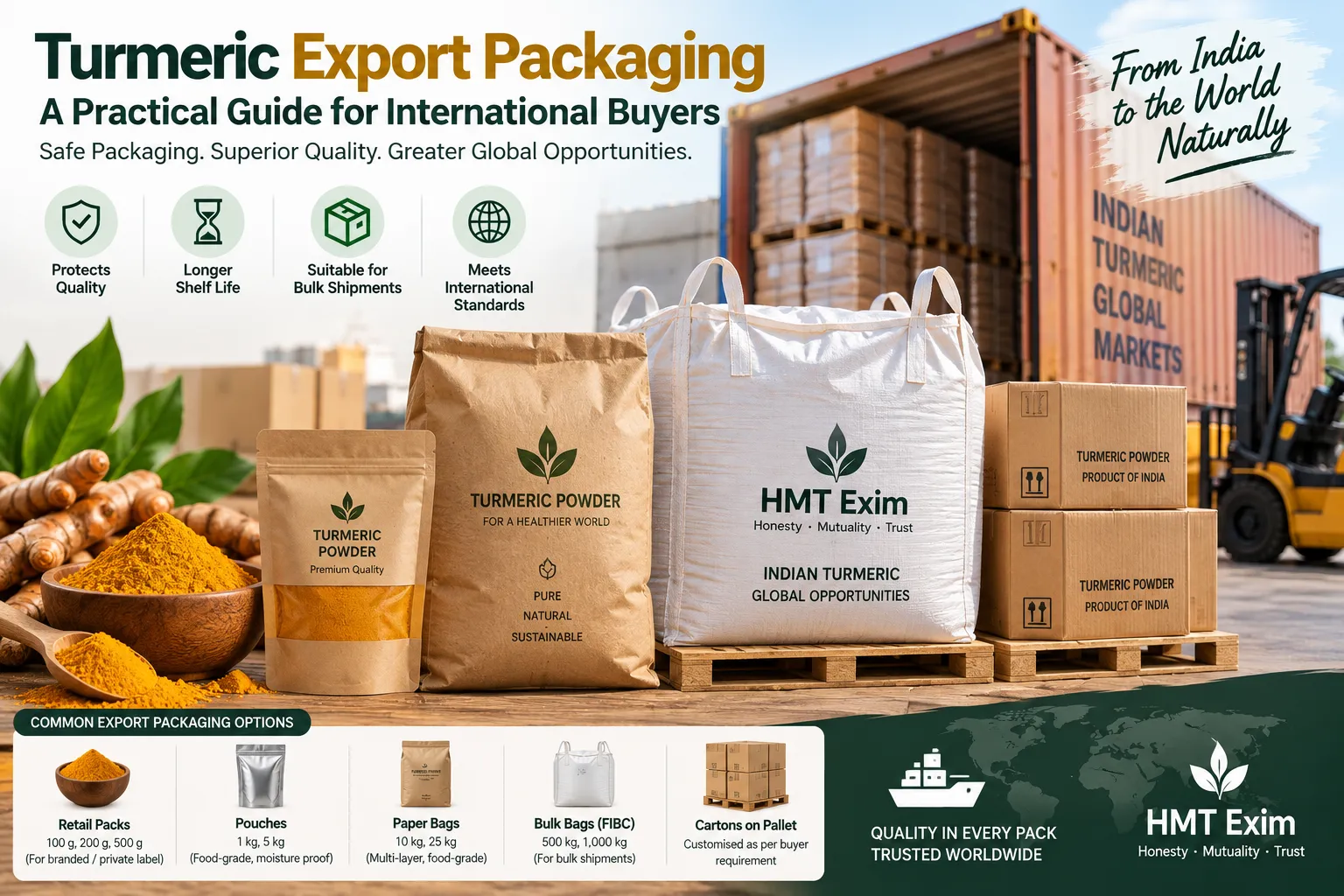
You can also review Turmeric Export Packaging: A Practical Guide for International Buyers for packaging-related considerations.
Frequently Asked Questions
What documents are required to export turmeric from India?
The exact documents depend on the shipment and destination. Common documents can include an IEC, commercial invoice, packing list, shipping bill and transport documentation, along with certificates required by the buyer or destination market.
Is a phytosanitary certificate always required for turmeric?
Not necessarily. The requirement depends on the destination country's import conditions and the form and nature of the product. Exporters should verify the current destination-specific requirement.
Does every turmeric shipment require a Certificate of Analysis?
Not necessarily as a universal regulatory requirement. However, international buyers may request a COA or laboratory report to verify agreed product specifications.
Why is document consistency important?
Consistent product descriptions, quantities, weights, package counts and shipping information reduce the risk of avoidable document discrepancies during customs clearance and commercial processing.
Does the destination country affect export compliance?
Yes. Import regulations and documentation requirements can vary by destination, product form and intended use.
Final Takeaway
Turmeric export compliance is a combination of accurate commercial documentation, applicable Indian export procedures and destination-market requirements.
For exporters, the most effective approach is to establish the document requirements early, verify the applicable product classification and destination rules, and cross-check all shipment information before dispatch.
For buyers, requesting the required documentation and product testing information before shipment can provide greater visibility into the incoming consignment.
If you are sourcing turmeric from India and want to discuss product specifications, documentation or shipment requirements, contact HMT Exim.