India is an important source of turmeric for international trade, but choosing an export market is not simply a matter of finding a country that imports turmeric.
For an Indian exporter, the more useful question is whether a particular market has buyers whose requirements match the product, quality specifications, packaging capability, compliance position and commercial terms the exporter can provide.
This guide explains how exporters can evaluate turmeric markets and how international buyers can assess potential Indian suppliers.
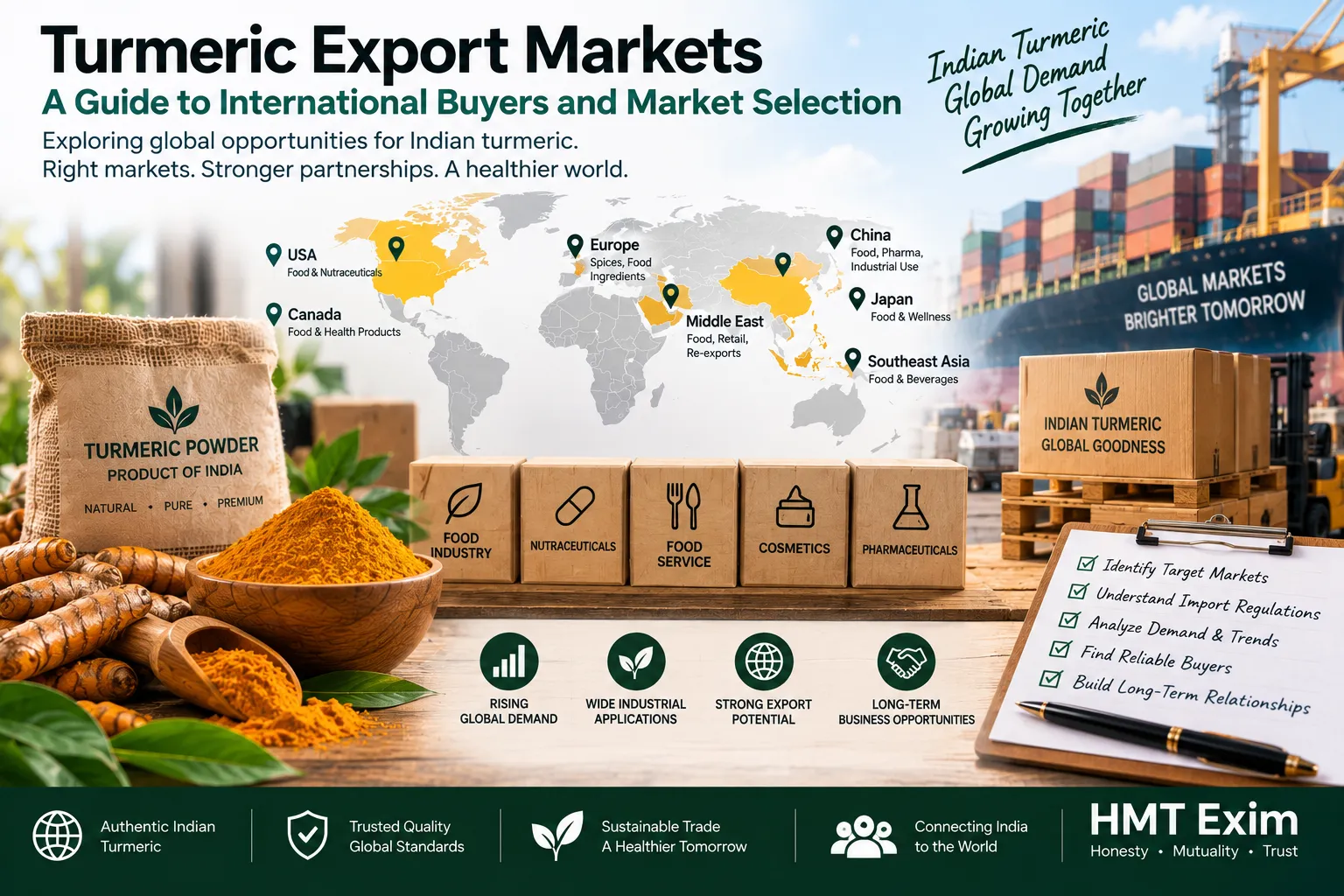
What Makes a Turmeric Export Market Attractive?
A useful market assessment looks at several factors together rather than focusing only on import volume.
- Import demand
- Buyer types
- Product form
- Quality requirements
- Food-safety regulations
- Packaging expectations
- Competitive landscape
- Logistics and freight considerations
- Payment practices
- Potential for repeat purchasing
A market with significant imports may still be unsuitable for an exporter if its buyers require specifications, certifications or commercial conditions the exporter cannot consistently meet.
Turmeric Markets Can Differ by Product Form
International demand is not limited to one type of turmeric. Buyers may source whole turmeric fingers, turmeric powder or specific grades designed for food, ingredient, spice-blending or other applications.
This distinction matters because the same country can contain different buyer segments with different specifications.
An exporter should therefore identify the product requirement before evaluating the market itself.
Whole Turmeric vs. Turmeric Powder Buyers
Buyers should define the required specification before comparing suppliers or quotations.
Types of International Turmeric Buyers
Turmeric can be purchased internationally by several types of businesses.
- Spice importers
- Food ingredient distributors
- Spice processors and blenders
- Food manufacturers
- Seasoning companies
- Private-label food businesses
- Wholesale distributors
- Manufacturers using turmeric as an ingredient
Each buyer group may have different requirements for packaging, documentation, minimum order quantities, testing and delivery.
How Exporters Should Research Turmeric Markets
Market research should begin with trade data and then move toward individual buyer research.
Trade statistics can help identify countries importing turmeric, while company-level research helps determine whether actual importers, distributors or manufacturers are potential customers.
Useful information to compare includes:
- Import value and quantity
- Import trend over multiple years
- Average import value where reliable data is available
- Major supplier countries
- Market concentration
- Buyer and distributor presence
- Applicable import regulations
Trade data should be interpreted carefully because reported values can be influenced by product classification, re-export activity, reporting methods and differences between customs datasets.
Do Not Select a Market Based Only on Import Volume
Large import volume can indicate substantial demand, but it does not automatically mean that a new exporter will find buyers easily.
Established suppliers may already have long-term relationships with importers. Buyers may also have strict approval procedures or established quality specifications.
Market selection should therefore combine demand analysis with buyer accessibility and supplier capability.
What International Buyers Look for in an Indian Turmeric Supplier
When evaluating an Indian exporter, buyers may consider:
- Product specification
- Consistency between batches
- Curcumin specification where applicable
- Moisture
- Microbiological quality
- Contaminant and residue compliance
- Packaging
- Documentation
- Sample approval
- Production and supply capacity
- Communication and order execution
For a detailed quality perspective, see 2%, 3%, 4% or 5% Curcumin Turmeric: Which Grade Is Right for Your Business?.
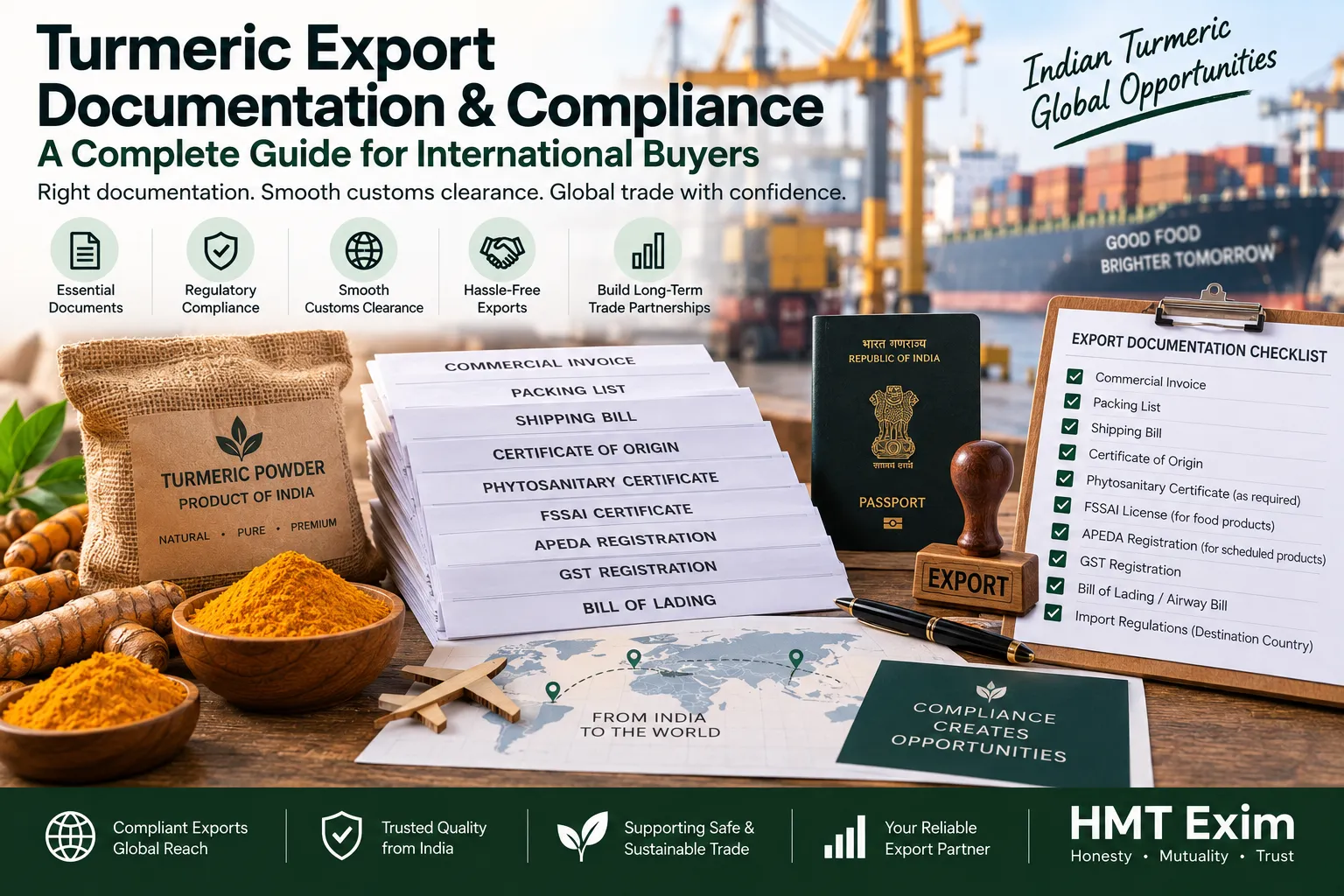
Why Destination Regulations Matter
Food import requirements differ between markets. A turmeric shipment may need to meet requirements concerning food safety, contaminants, pesticide residues, labeling, packaging and documentation.
Exporters should establish the requirements of the intended destination before finalizing the product specification.
Importers can also provide their supplier with their internal specification and destination-market requirements before requesting a commercial quotation.
Turmeric Market Selection and Compliance
A market may appear commercially attractive but become more difficult to serve if the buyer requires testing, certifications, labeling or other compliance measures that are not included in the exporter's normal process.
This is why market research and compliance research should be performed together.
For the documentation side, read Turmeric Export Documentation & Compliance.
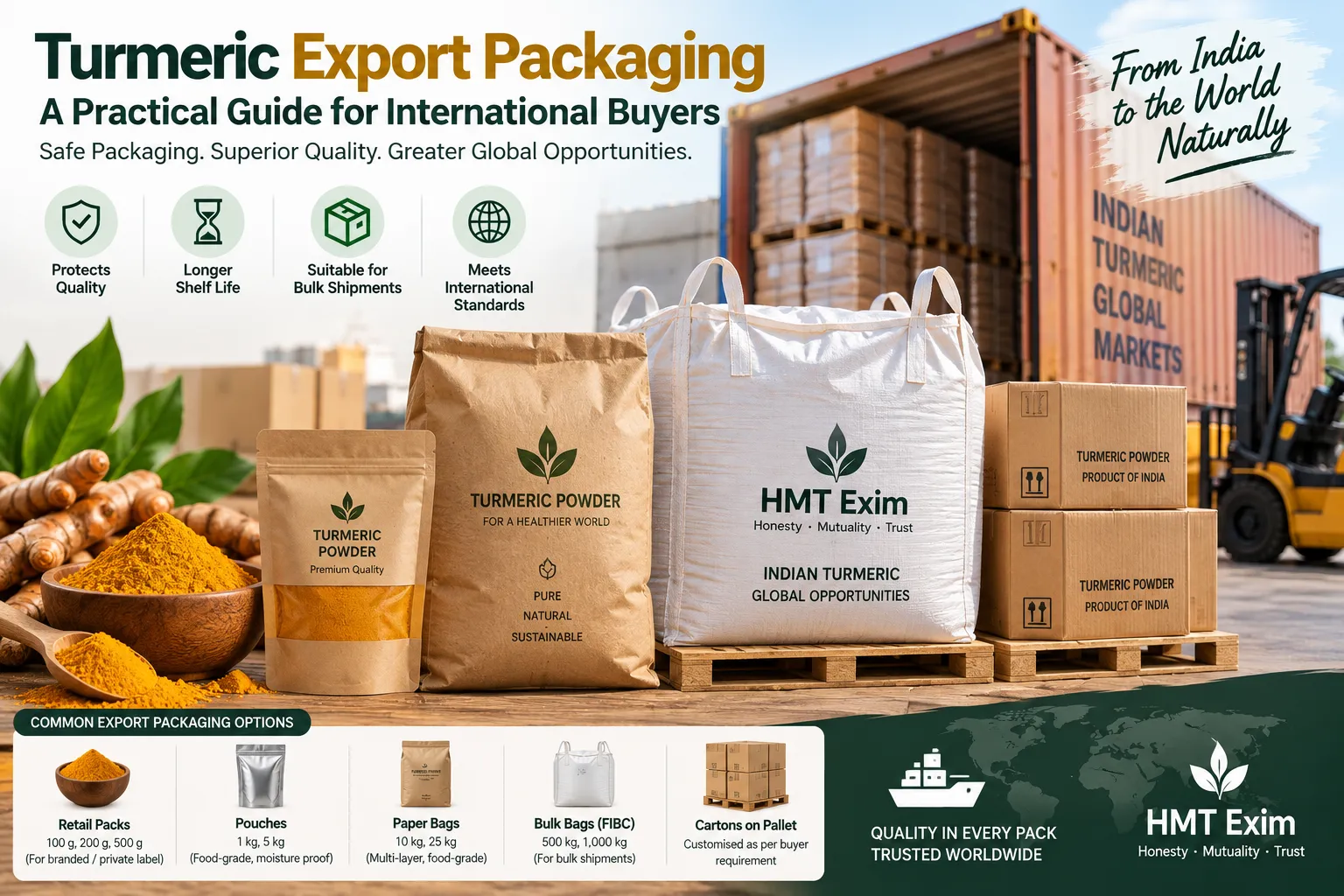
Packaging Expectations Can Differ by Market
International buyers may request different packing formats depending on their warehouse, manufacturing process, distribution model and local market requirements.
Bulk orders can involve different bag weights, inner liners, palletization or customized private-label packaging.
Before approaching a market, exporters should understand whether their existing packaging capability can accommodate the buyer segment they intend to target.
See Turmeric Export Packaging for a detailed discussion of bulk export packaging.
Price Is Only One Part of Market Selection
Exporters naturally compare markets based on prices, but the lowest apparent market price is not necessarily the most useful commercial benchmark.
Freight, insurance, duties, testing, packaging, port charges, financing costs, payment terms and other transaction expenses can influence the final economics of a shipment.
Buyers should compare quotations on a consistent basis, including the applicable Incoterm and exactly what is included in the quoted price.
Understanding Competition
Indian turmeric competes with suppliers from other producing and trading countries. Buyers may already have approved suppliers and established procurement channels.
Instead of competing only on price, exporters should understand the specific purchasing criteria of the target buyer.
Potential areas of differentiation can include consistent specifications, suitable packaging, documentation quality, responsiveness and the ability to meet recurring requirements.
Building a Turmeric Market Entry Strategy
A practical market-entry process can be divided into several stages:
- Identify countries with relevant import demand.
- Study the product forms imported by those markets.
- Review destination-market compliance requirements.
- Identify genuine importers, distributors and manufacturers.
- Study their product specifications and purchasing requirements.
- Prepare a suitable product and documentation package.
- Approach qualified buyers with a relevant offer.
- Send samples or technical information when requested.
- Confirm commercial terms and shipment requirements.
- Build repeat business after successful delivery.
This approach is more targeted than sending the same generic quotation to every company found in a country.
What Should a Turmeric Exporter Include in a Buyer Introduction?
An initial B2B introduction should give the buyer enough information to determine whether the supplier is relevant without overwhelming them.
Useful information can include the product form, available specifications, packing options, origin, documentation capability, intended application and the supplier's contact details.
Once the buyer shows interest, more detailed technical and commercial information can be shared.
How Buyers Can Evaluate Indian Turmeric Suppliers
International buyers can use a structured supplier-evaluation process:
- Verify the supplier's business information.
- Define the required turmeric specification.
- Request a representative sample where appropriate.
- Review relevant laboratory documentation.
- Confirm packaging requirements.
- Clarify Incoterms and shipment responsibilities.
- Confirm payment terms.
- Review export documentation requirements.
- Start with an order size appropriate to the buyer's approval process.
A supplier comparison is more meaningful when all suppliers are evaluated against the same written specification.
Can One Turmeric Market Support Long-Term Business?
Long-term export relationships depend on more than the first purchase.
Repeat buyers generally need consistent product quality, reliable documentation, predictable communication and dependable shipment execution.
For exporters, this means market selection should consider whether the target buyer segment can support recurring orders rather than focusing exclusively on obtaining a single transaction.
Market Research Should Be Updated
Import demand, regulations, freight conditions, exchange rates, competition and buyer requirements can change over time.
A market assessment should therefore be treated as an ongoing commercial activity rather than a one-time report.
Before entering a new market, exporters should verify current trade data and destination-country requirements rather than relying on old market information.
HMT Exim and International Turmeric Sourcing
HMT Exim is an India-based export business supplying turmeric and other agricultural products to international B2B buyers. Turmeric can be discussed according to the buyer's required form, specification, packaging and shipment requirements.
For buyers evaluating Indian turmeric suppliers, the Turmeric product page provides a starting point for discussing sourcing requirements.
For product-specific enquiries, packaging requirements or export discussions, contact HMT Exim.
Frequently Asked Questions
Which countries import turmeric?
Turmeric is traded internationally across multiple markets. The relevant markets for an exporter depend on the product form, specification, regulations, competition and buyer demand. Current trade data should be checked before selecting a target market.
Is a large turmeric-importing country automatically a good export market?
No. Import volume is one market indicator. Buyer accessibility, competition, regulations, product requirements, logistics and commercial conditions should also be evaluated.
What turmeric products can be exported?
International trade can include whole turmeric and turmeric powder, with specifications varying according to the buyer and intended application.
What do international turmeric buyers usually check?
Buyers may assess product specifications, consistency, laboratory testing, food-safety compliance, packaging, documentation, supply capability and commercial terms.
How can an Indian exporter find genuine turmeric buyers?
Exporters can combine trade-data research with company-level research to identify importers, distributors, processors and manufacturers that actually handle the relevant product.
Should exporters compete only on price?
Price is an important commercial factor, but buyers may also evaluate quality consistency, compliance, packaging, documentation, reliability and supply capability.
Final Takeaway
Turmeric export-market selection should be based on the fit between market demand and the exporter's actual capabilities.
Trade data can identify potential markets, but successful B2B export development requires a second layer of research: finding genuine buyers, understanding their specifications, checking destination requirements and building an offer that matches their purchasing needs.
For exporters from India, the objective should be to develop sustainable buyer relationships rather than simply identify countries with high import statistics.
If you are looking to source turmeric from India for wholesale, manufacturing or distribution, contact HMT Exim with your required product specification and destination market.