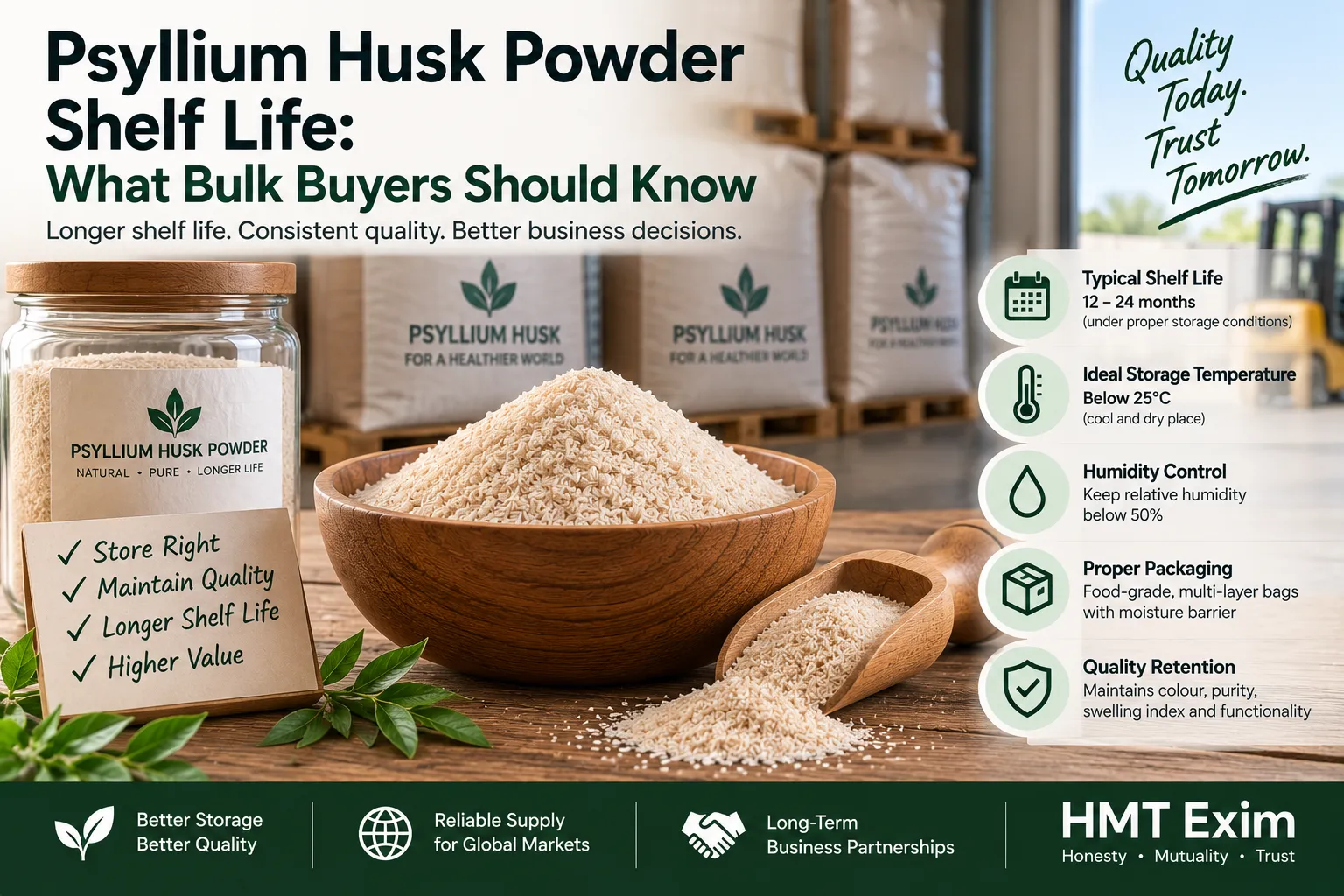
For a bulk buyer, shelf life is not simply a date printed on a package. It is closely connected to product quality, packaging, storage conditions and how the material is handled throughout the supply chain.
This becomes particularly important when importing Psyllium Husk Powder in commercial quantities. A shipment may spend time in international transit, customs clearance, warehouse storage and manufacturing inventory before the product is finally consumed.
Understanding the factors that influence shelf life helps buyers establish better purchasing specifications and storage procedures without relying on a single number.
What Does Shelf Life Mean for Psyllium Husk Powder?
Shelf life is the period during which a product is expected to remain within its specified quality requirements when stored under the recommended conditions.
For Psyllium Husk Powder, buyers should consider shelf life together with the product specification, packaging system and storage conditions.
A shelf-life statement should therefore not be viewed independently from the conditions under which the product is stored.
What Factors Affect Psyllium Husk Powder Shelf Life?
Several factors can influence how well a bulk shipment maintains its condition during storage:
- Initial product quality
- Moisture level
- Packaging integrity
- Storage environment
- Temperature and humidity exposure
- Handling practices
- Length of storage
- Batch management
These factors work together. Good packaging cannot compensate for poor storage indefinitely, and a suitable warehouse cannot correct an unsuitable product received from the supplier.
Why Moisture Matters
Moisture management is an important consideration for dry powdered ingredients.
Exposure to environmental moisture can affect the physical condition and handling characteristics of a powdered product. For this reason, buyers should confirm the agreed moisture specification and understand how the product is protected during transportation and storage.
Buyers should also avoid assuming that a product's stated shelf life applies regardless of storage conditions.
Packaging and Shelf Life Are Connected
Packaging provides a barrier between the product and its surrounding environment.
For bulk Psyllium products, buyers may discuss packaging options such as food-grade bags with suitable inner liners or other formats appropriate for the shipment and intended use.
Before ordering, clarify:
- Packaging material
- Bag size
- Inner-liner specification
- Closure method
- Protection during transportation
- Labelling and batch identification
Packaging should be selected according to the product, destination and buyer's storage and handling process.
Storage Conditions After Import
Once the shipment reaches the buyer, warehouse management becomes an important part of maintaining product condition.
Bulk Psyllium Husk Powder should be stored in a clean, dry and appropriately managed environment that protects the packaging and product from unnecessary exposure to moisture and contamination.
Good storage practices include:
- Protecting bags from moisture
- Maintaining clean storage areas
- Preventing packaging damage
- Keeping products appropriately organized
- Maintaining batch identification
- Using a suitable stock-rotation system
For more detail, read Why Psyllium Husk Storage Matters for Long-Term Bulk Buyers.
Does Psyllium Husk Powder Have a Fixed Shelf Life?
Buyers should not assume that one universal shelf-life period applies to every Psyllium Husk Powder product.
Shelf life can depend on the product specification, processing, packaging, storage conditions and the supplier's validated product information.
The correct commercial approach is to obtain the shelf-life statement and storage requirements for the specific product being purchased.
What Should a Bulk Buyer Ask the Supplier?
Before placing an order, buyers should request clear information about:
- Declared shelf life
- Date of manufacture or production where applicable
- Recommended storage conditions
- Packaging format
- Moisture specification
- Batch identification
- Certificate of Analysis where applicable
- Handling recommendations
This information allows the buyer to calculate how much usable inventory can realistically be maintained.
Shelf Life vs. Quality Specification
Shelf life does not replace quality testing.
A buyer should continue to evaluate the product against the agreed specifications, particularly when the material has been stored for an extended period.
Our complete Psyllium Husk Specifications guide explains the main technical parameters buyers should review.
How Long-Term Buyers Can Manage Shelf Life
Bulk purchasing can reduce purchasing frequency, but it also means inventory may remain in storage for longer periods.
Long-term buyers can manage this by:
- Recording batch and receipt dates.
- Maintaining suitable warehouse conditions.
- Using appropriate stock rotation.
- Inspecting packaging periodically.
- Following the supplier's storage recommendations.
- Planning purchasing quantities around actual consumption.
This approach helps prevent unnecessary inventory ageing.
Why Batch Traceability Matters
When multiple shipments are stored simultaneously, batch identification becomes particularly useful.
Maintaining records allows buyers to connect inventory with its shipment, production information and quality documentation.
This can make it easier to investigate a quality concern or identify which inventory should be consumed first.
Does Powder Require Different Handling From Husk?
The physical form can influence handling requirements, particularly because powdered material has a different particle structure from conventional Psyllium Husk.
Buyers should therefore confirm the storage and packaging requirements for the exact product being purchased rather than applying assumptions from another Psyllium product.
See Psyllium Husk vs. Psyllium Khakha Powder for a comparison of the two product forms.
What Should Buyers Check Before Using Older Stock?
When inventory has been stored for an extended period, buyers should confirm that the packaging remains intact and that the product continues to meet the applicable internal acceptance requirements.
Depending on the buyer's quality system and intended application, additional testing may be appropriate before use.
Particular attention should be given to any visible packaging damage, unexpected changes in physical condition or evidence of unsuitable storage.
How HMT Exim Supports Bulk Psyllium Buyers
HMT Exim supplies export-oriented Psyllium products for international B2B buyers. Product specifications, packaging requirements and shipment details can be discussed according to the buyer's intended application and commercial requirements.
Explore the Psyllium Husk product page or contact HMT Exim to discuss bulk requirements and export packaging.
Frequently Asked Questions
What determines the shelf life of Psyllium Husk Powder?
Shelf life depends on the specific product, quality characteristics, packaging, storage conditions and the supplier's applicable shelf-life information.
Does moisture affect Psyllium Husk Powder shelf life?
Moisture exposure can affect the condition and handling characteristics of dry powdered ingredients, which is why moisture control and suitable packaging are important.
Should bulk buyers ask for a shelf-life statement?
Yes. Buyers should obtain the applicable shelf-life information and recommended storage conditions for the specific product before ordering.
Can Psyllium Husk Powder be stored for a long period?
It can be stored according to the supplier's stated conditions and shelf-life requirements. Buyers should manage inventory carefully and protect the product from unsuitable environmental exposure.
What packaging is suitable for bulk Psyllium Powder?
The appropriate packaging depends on the product, shipment, destination and buyer requirements. Food-grade bags with suitable protective inner packaging may be considered where appropriate.
Should old stock be tested before use?
Depending on the buyer's quality system, storage period and intended application, additional inspection or testing may be appropriate before using older inventory.
Final Takeaway
Psyllium Husk Powder shelf life should be considered as part of a complete quality and storage system rather than as a standalone date.
For bulk buyers, the key considerations are the initial product specification, moisture control, packaging integrity, storage environment, batch traceability and appropriate stock rotation.
Before placing a long-term order, confirm the specific product's shelf-life information and storage requirements with the supplier and plan inventory accordingly.
If you are sourcing Psyllium Husk Powder from India for bulk or recurring requirements, contact HMT Exim to discuss your product specification, packaging and export requirements.