When sourcing products from India, international buyers often encounter two types of exporters: merchant exporters and manufacturer exporters. Although both can legally export products, they operate differently and offer different commercial advantages.
Understanding this distinction helps buyers choose the right export partner, negotiate better commercial terms and avoid confusion during supplier evaluation.
This guide explains how merchant exporters and manufacturer exporters work, their documentation responsibilities, advantages, limitations and which model may be better suited for different types of buyers.
Quick Answer
A manufacturer exporter produces goods in its own manufacturing facility and exports those products directly.
A merchant exporter purchases products from manufacturers, farmers, processors or authorized suppliers and exports them under its own export business.
Both business models can participate in international trade, but their sourcing methods, production control and commercial roles differ.
Merchant Exporter vs Manufacturer Exporter
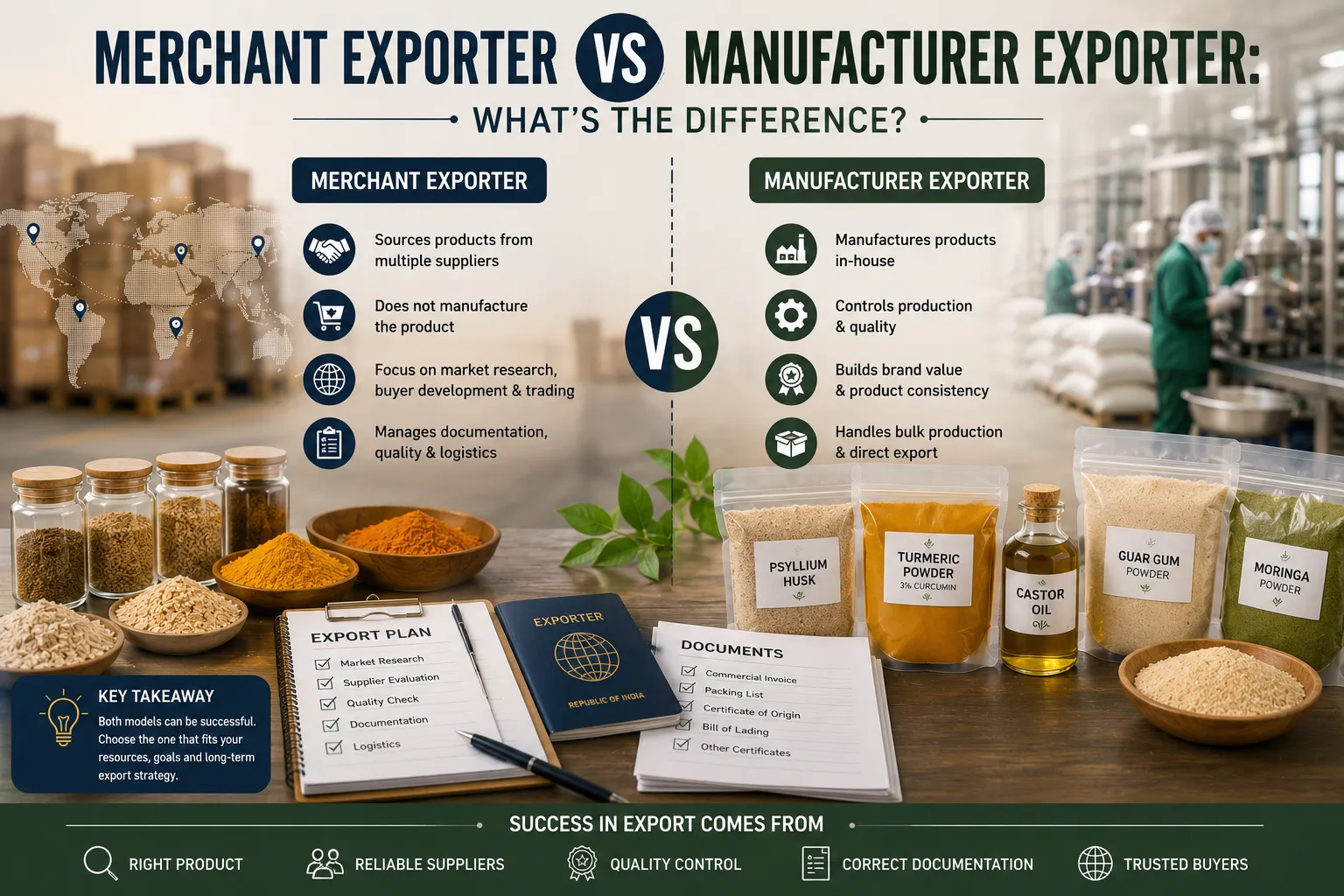
| Parameter | Merchant Exporter | Manufacturer Exporter |
|---|---|---|
| Manufacturing | Sources products from manufacturers and suppliers | Produces products in-house |
| Factory ownership | Not necessarily | Own manufacturing facility |
| Product sourcing | Multiple approved suppliers | Own production |
| Product range | Usually broader | Often limited to manufactured products |
| Customization | Coordinates with suppliers | Direct production control |
| Export documentation | Prepared by exporter | Prepared by exporter |
What Is a Merchant Exporter?
A merchant exporter purchases goods from manufacturers, farmers, processors, traders or other authorized suppliers and exports them to international buyers.
Instead of operating a manufacturing plant, the merchant exporter focuses on supplier selection, quality coordination, export documentation, logistics and buyer communication.
This business model allows exporters to source products from different regions according to buyer requirements.
How a Merchant Exporter Works
- Buyer shares product requirements.
- Exporter identifies suitable suppliers.
- Samples are evaluated.
- Quality requirements are confirmed.
- Packaging is arranged.
- Export documentation is prepared.
- Shipment is coordinated.
This coordinated approach can simplify procurement for buyers who need reliable export management alongside product sourcing.
What Is a Manufacturer Exporter?
A manufacturer exporter owns or operates manufacturing facilities and exports products produced within those operations.
Because production is handled internally, manufacturer exporters often have direct oversight of manufacturing schedules, production processes and factory operations.
However, they may specialize in a narrower product range compared with merchant exporters.
Advantages of Merchant Exporters
Merchant exporters offer several practical advantages for international buyers.
- Access to multiple sourcing regions
- Wider product portfolio
- Flexible supplier coordination
- Export documentation support
- Logistics coordination
- Ability to consolidate products from different suppliers
For buyers importing multiple products, working with a merchant exporter can reduce procurement complexity by providing a single export point of contact.
Advantages of Manufacturer Exporters
Manufacturer exporters can provide benefits that relate directly to production management.
- Direct production oversight
- Factory-level process control
- Production scheduling
- Manufacturing consistency
- Technical product knowledge
These advantages can be valuable when buyers require factory-specific manufacturing arrangements.
Which Is Better for International Buyers?
Neither business model is universally better.
The right choice depends on what the buyer needs.
| Buyer Requirement | Suitable Option |
|---|---|
| Multiple product sourcing | Merchant Exporter |
| Factory-specific production | Manufacturer Exporter |
| Supplier coordination | Merchant Exporter |
| Single manufacturing facility | Manufacturer Exporter |
| Export management support | Merchant Exporter |
Rather than choosing based only on business type, buyers should evaluate whether the exporter can consistently meet their commercial and quality requirements.
Export Documentation Responsibilities
Regardless of whether an exporter is a merchant exporter or manufacturer exporter, export documentation remains an essential part of international trade.
Depending on the shipment, documentation may include:
- Commercial Invoice
- Packing List
- Bill of Lading
- Certificate of Origin
- Phytosanitary Certificate where required
- Certificate of Analysis where applicable
- Other destination-specific documents
Document requirements vary according to product, destination country and applicable regulations.
For a complete explanation, see our Complete Export Process from India.
How Merchant Exporters Source Products
Professional merchant exporters typically build supplier networks across different production regions.
For example, sourcing can involve:
- Farmer networks
- APMC markets
- Processing facilities
- Approved manufacturers
- Product inspections
- Quality verification before shipment
This sourcing flexibility allows merchant exporters to match buyer specifications with appropriate supply sources while coordinating export logistics and documentation. HMT Exim's company profile also describes direct sourcing from farmers and APMC mandis, quality checks and export-ready packaging as part of its operating approach.
How Buyers Should Evaluate Any Exporter
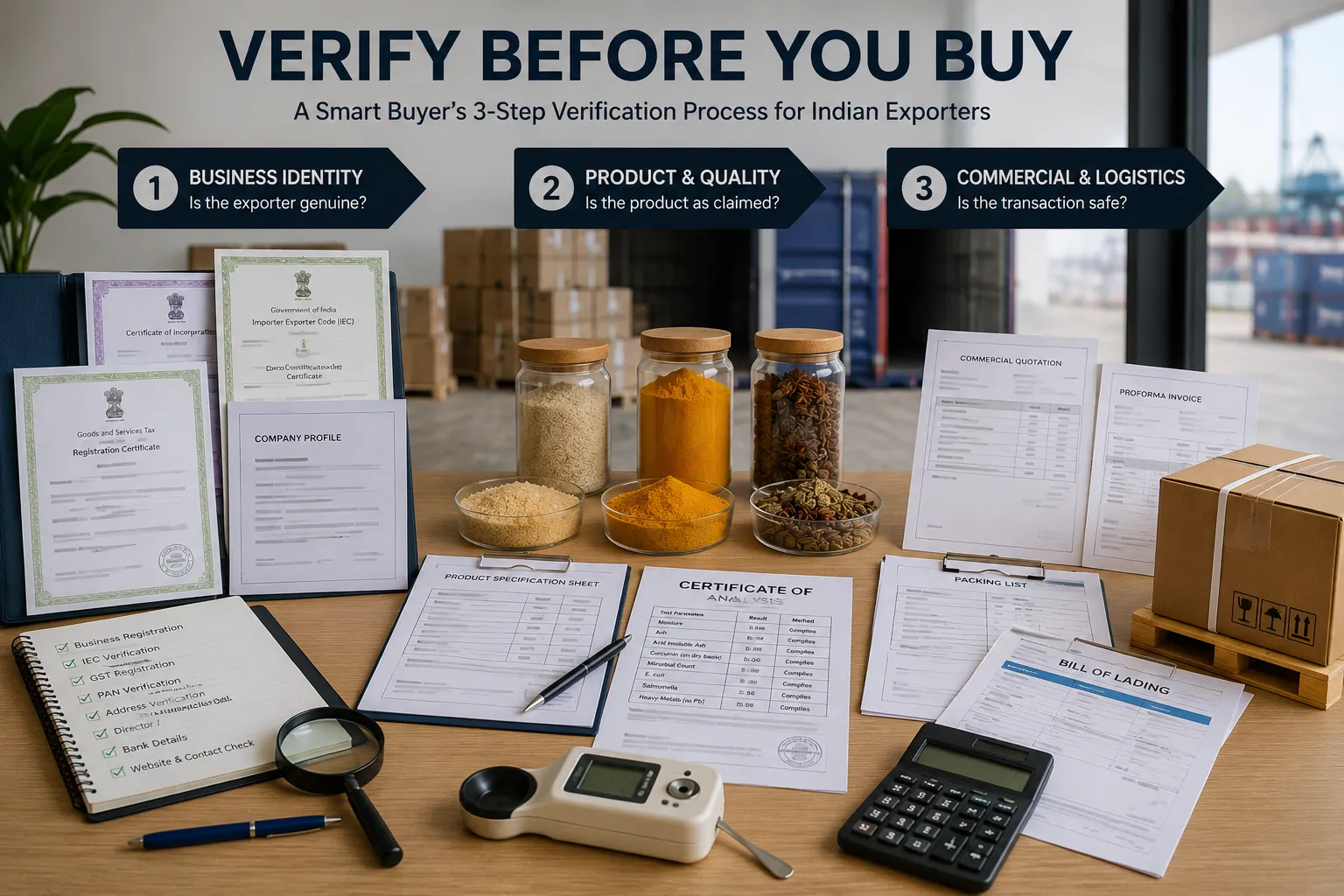
Whether the supplier is a merchant exporter or manufacturer exporter, buyers should perform proper due diligence.
- Verify business registration.
- Review export documentation.
- Request product specifications.
- Review quality documentation.
- Evaluate communication.
- Approve representative samples.
- Confirm packaging.
- Clarify commercial terms.
Our guide on How to Verify an Indian Exporter provides a practical verification framework.
Merchant Exporters and Product Consolidation
One significant advantage of merchant exporters is product consolidation.
A buyer importing multiple Indian products may prefer receiving a consolidated shipment instead of coordinating several manufacturers independently.
This can simplify communication, documentation coordination and shipment planning.
HMT Exim's Export Approach
HMT Exim operates as a Gujarat-based export company focused on sourcing quality Indian products through supplier networks, quality checks and export coordination. The company profile describes sourcing from farmer networks and APMC markets, export-ready packaging, quality inspections and support for international documentation requirements.
Buyers interested in Indian functional ingredients and spices can also explore:
Merchant Exporter Checklist for Buyers
- ☐ Business registration is verified
- ☐ Export capability is confirmed
- ☐ Product specifications are documented
- ☐ Representative samples are evaluated
- ☐ Quality documentation is reviewed
- ☐ Packaging is confirmed
- ☐ Commercial terms are agreed
- ☐ Shipment documentation is clarified
Frequently Asked Questions
Can a merchant exporter legally export products from India?
Yes. Merchant exporters can export products by sourcing them from eligible manufacturers or suppliers while handling export documentation and shipment coordination.
Does a merchant exporter own a factory?
Not necessarily. Merchant exporters primarily coordinate sourcing, quality checks, documentation and exports rather than manufacturing every product themselves.
Who prepares export documents?
The exporter handling the shipment is generally responsible for preparing the applicable export documentation required for that transaction.
Which model is better for buying multiple products?
Merchant exporters can be advantageous when buyers want consolidated sourcing across multiple products and suppliers.
Should buyers verify both merchant and manufacturer exporters?
Yes. Due diligence should be performed regardless of the exporter's business model.
Final Takeaway
Merchant exporters and manufacturer exporters both play important roles in international trade. Manufacturer exporters control production directly, while merchant exporters focus on sourcing, supplier coordination, quality verification and export management.
For many international buyers, the most important decision is not choosing between the two business models—it is selecting an exporter that consistently meets quality specifications, documentation requirements and shipment commitments.
If you are looking for a reliable Indian export partner for Psyllium Husk, Turmeric Powder or other Indian products, contact HMT Exim to discuss your sourcing requirements.