Finding international buyers is one of the most important parts of building an export business from India.
But successful buyer sourcing is not simply about collecting thousands of email addresses.
A better approach is to identify countries where demand exists, find companies that actually buy or distribute your type of product, research those companies, identify the right contact person, present a relevant offer and systematically follow up.
For Indian exporters of products such as spices, agricultural ingredients and food products, this process can create a more focused and sustainable international sales pipeline.
Quick Answer: How Can Indian Exporters Find International Buyers?
Indian exporters can find international buyers through a combination of:
- Import and trade data
- Target-market research
- Importer and distributor research
- Company websites
- B2B marketplaces
- Industry directories
- Trade fairs and exhibitions
- Chambers of commerce and trade associations
- LinkedIn and professional networks
- Existing business referrals
The most effective approach is usually a combination of several sources rather than relying on one platform.
Start With the Product, Not the Buyer List
Before searching for buyers, define exactly what you are selling.
An exporter should know:
- Product name
- Product form
- Grade
- Technical specifications
- Packaging options
- Minimum order quantity
- Available quantity
- Quality documentation
- Target price range
- Shipping options
- Origin
- Expected lead time
For example, a turmeric exporter should be able to clearly explain whether the buyer is looking for turmeric fingers or powder, the required curcumin specification, mesh size, moisture requirement, packaging and destination.
A psyllium husk exporter may need to discuss grade, purity, mesh, swelling characteristics, moisture and packaging.
Without a clear product specification, buyer research becomes much less precise.
Step 1: Choose the Right Export Market
Do not begin by trying to sell to every country in the world.
Start by identifying markets where your product has a reasonable commercial opportunity.
Consider:
- Import demand
- Existing imports from India
- Competing supplier countries
- Product regulations
- Import duties
- Freight costs
- Market size
- Buyer concentration
- Payment risk
- Ease of communication
- Product applications
For a new exporter, a focused list of priority markets is usually easier to manage than an unrestricted global search.
Step 2: Identify the HS Code
The Harmonized System code is important when researching international trade.
An HS code helps connect the product to import and export data.
For example, exporters researching turmeric can use the relevant HS classification to investigate which countries import the product and which companies may be active in that trade.
The exact HS code should always be verified for the product and applicable customs classification.
Step 3: Research Countries Before Companies
A common mistake is to immediately search for companies.
Start at the country level.
Ask:
- Which countries import this product?
- How much do they import?
- Is demand stable?
- Is demand increasing?
- Which countries already buy from India?
- Which supplier countries compete with India?
- What type of buyers operate in that market?
This creates a market shortlist before you spend time researching individual companies.
Step 4: Identify the Right Buyer Type
Not every company that sells a product is the same type of buyer.
Potential international buyers can include:
Importers
Importers purchase products internationally and bring them into their domestic market.
Distributors
Distributors may purchase larger quantities and supply multiple downstream customers.
Wholesalers
Wholesalers typically purchase products in commercial quantities for resale.
Food Manufacturers
Manufacturers may purchase spices and agricultural ingredients as raw materials.
Retail Brands
Retail companies may source finished products or private-label products.
Private-Label Companies
These companies may require products packed under their own branding.
Ingredient Suppliers
Ingredient distributors can purchase products for supply to manufacturers and other businesses.
The correct buyer type depends on the product.
Step 5: Find Companies That Already Import Similar Products
One of the strongest indicators of commercial relevance is existing purchasing activity.
Instead of searching only for companies that say:
"We are looking for suppliers."
Research companies that already:
- Import the product
- Distribute similar products
- Manufacture products using the ingredient
- Sell the product commercially
- Source from international suppliers
An existing importer may already understand the product, documentation and international purchasing process.
Step 6: Use Trade Data for Buyer Research
Trade data can help exporters move from general market research to company-level research.
Depending on the available data source, an exporter may be able to investigate:
- Importing countries
- Exporting countries
- Product classifications
- Shipment activity
- Import volumes
- Supplier countries
- Buyer companies where company-level data is available
Trade data should be treated as a research tool rather than automatic proof that a company is currently ready to purchase.
A company may have imported a product previously but have no immediate purchasing requirement.
Step 7: Search Company Websites
Once potential companies are identified, visit their websites.
Look for:
- Product categories
- Brands
- Distribution activities
- Import activities
- Supplier information
- Markets served
- Contact information
- Procurement or purchasing departments
This step helps determine whether the company is actually relevant to your product.
Step 8: Identify the Right Decision-Maker
Sending an export proposal to a generic email address is less effective than reaching the appropriate business contact when that information is publicly available.
Potential contacts include:
- Procurement Manager
- Purchasing Manager
- Import Manager
- Sourcing Manager
- Commercial Manager
- Category Manager
- Director
- Owner
The appropriate contact depends on the size and structure of the company.
Step 9: Research the Buyer Before Contacting Them
Before sending an email or message, understand the company.
Check:
- What products do they sell?
- Which markets do they serve?
- Are they an importer or distributor?
- Do they already sell Indian products?
- What product specifications do they appear to use?
- What packaging formats do they offer?
- Do they have private-label products?
- Who is responsible for purchasing?
This allows the exporter to write a relevant message rather than sending a generic advertisement.
Step 10: Prepare a Professional Export Introduction
The first message should be short and relevant.
A useful introduction can include:
- Company name
- Product
- Origin
- Key specification
- Packaging
- Ability to provide samples
- Destination capability
- Contact information
For example:
We are HMT Exim, an Indian exporter based in Surat, Gujarat, supplying Indian spices and agricultural products to international buyers. We are currently developing B2B supply relationships for products including turmeric and other Indian spices and can discuss specifications, packaging and shipment requirements based on your market.
The message should then move toward the buyer's actual requirement rather than becoming a long company advertisement.
Step 11: Do Not Send the Same Message to Every Buyer
A generic message such as:
"Dear Sir, we are leading exporters of all products. Please let us know if you have any requirement."
provides very little reason for the buyer to respond.
A better approach is to connect the product with the buyer's business.
For example:
We noticed that your company distributes spices to food manufacturers in your market. We would like to discuss whether you currently source Indian turmeric powder and whether you have a preferred curcumin, mesh and packaging specification.
The second message is more specific because it is based on buyer research.
Step 12: Use Samples Strategically
A serious buyer may request a sample before confirming a bulk order.
The sample discussion should establish:
- Product specification
- Quantity required
- Delivery address
- Packaging
- Testing requirements
- Expected evaluation criteria
A sample should be connected to a defined commercial opportunity rather than sent randomly to every lead.
Step 13: Qualify the Buyer
A lead is not automatically a buyer.
A useful qualification process can establish:
- Product required
- Required quantity
- Specification
- Packaging
- Destination
- Current sourcing
- Purchase frequency
- Required documentation
- Target shipment timeline
For example:
| Qualification Question | Why It Matters |
|---|---|
| What product do you require? | Confirms product fit |
| What specification? | Determines exact product |
| What quantity? | Determines commercial opportunity |
| What packaging? | Determines packing requirement |
| What destination port? | Helps estimate logistics |
| Do you currently import? | Indicates import experience |
| How frequently do you purchase? | Indicates potential repeat business |
| What documents are required? | Helps prepare compliance requirements |
Step 14: Separate Leads Into Priority Levels
Not every lead deserves the same amount of time.
A simple system can divide prospects into:
High Priority
The company imports the product, matches your product range and has an identifiable purchasing requirement.
Medium Priority
The company appears relevant but its current purchasing requirement is unclear.
Low Priority
The company has limited evidence of relevance or does not clearly match the product.
This allows the exporter to spend more time on commercially promising opportunities.
Step 15: Build a Buyer Database
Do not depend on memory.
Maintain a structured buyer database containing:
- Company name
- Country
- Website
- Buyer type
- Product
- Contact person
- Job title
- Phone
- Source of lead
- Product requirement
- Quantity
- Status
- Last contact
- Next follow-up
- Notes
This turns buyer sourcing into a repeatable sales process.
Step 16: Follow Up Systematically
A buyer may not respond to the first message.
Reasons can include:
- Wrong timing
- Busy procurement team
- Internal approval
- Seasonal purchasing
- Existing supplier contracts
- Message not reaching the decision-maker
Follow-up should therefore be structured and professional.
A simple sequence can be:
Initial introduction
↓
First follow-up
↓
Product specification discussion
↓
Sample discussion
↓
Quotation
↓
Commercial discussion
↓
Order
The exact timing should depend on the buyer and transaction.
Step 17: Build Trust Before Asking for a Large Order
International buyers need confidence in the supplier.
Useful trust signals can include:
- Clear company information
- Product specifications
- Quality documentation
- Samples
- Professional quotations
- Export documentation capability
- Transparent communication
- Consistent business identity
- Clear payment instructions
- Relevant certifications where applicable
Do not claim certifications, markets, customers or shipment experience that cannot be verified.
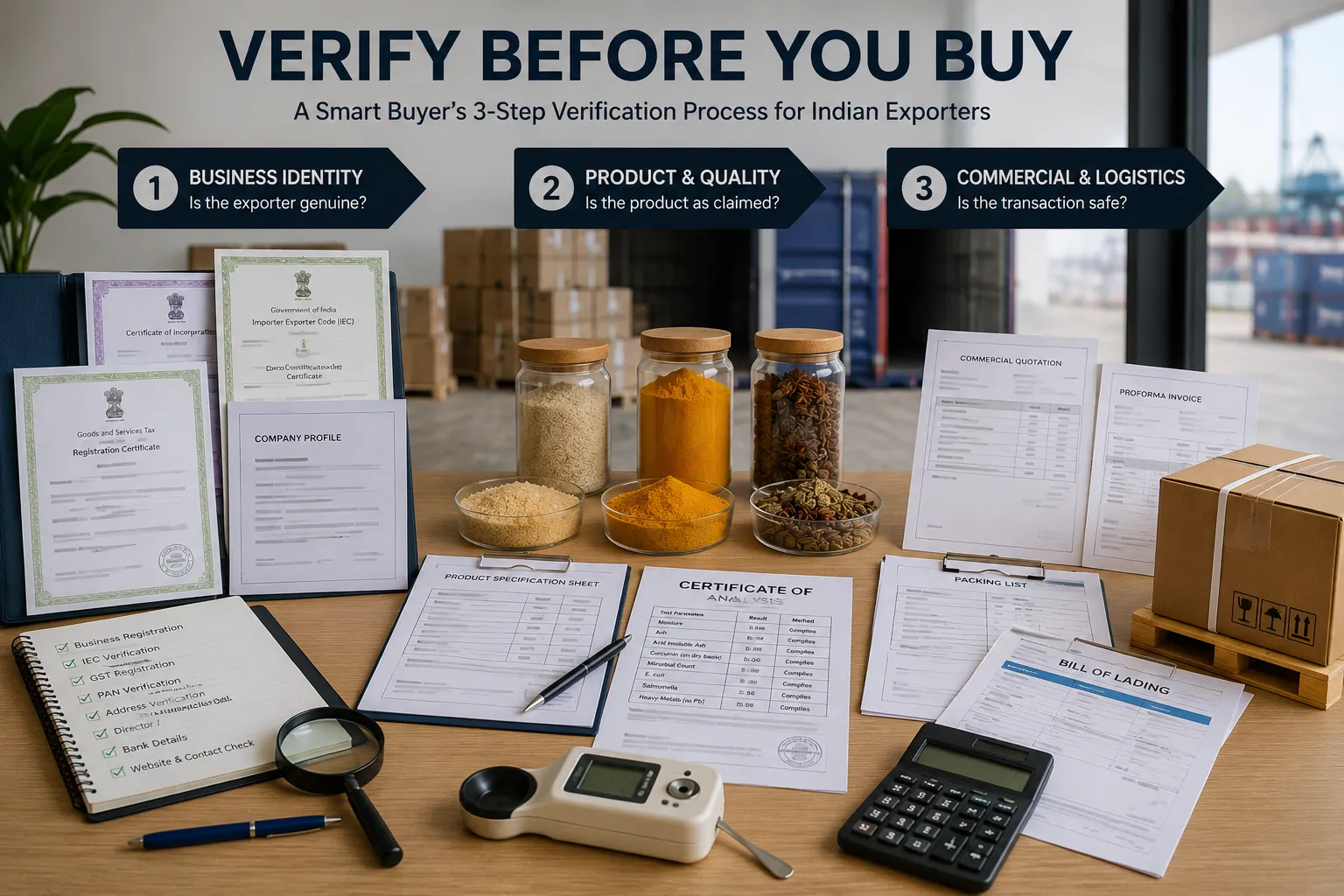
What Should an International Buyer Look for in an Indian Supplier?
The process works both ways.
An international buyer evaluating an Indian exporter should consider:
- Company identity
- Export credentials
- Product specifications
- Quality-control process
- Samples
- Testing documentation
- Packaging
- Commercial terms
- Payment terms
- Communication
- Shipment process
Supplier verification is an important part of international sourcing.
What Makes a Good Export Lead?
A strong export lead generally has several characteristics:
- The company operates in a relevant industry.
- The company sells or uses the product.
- The company imports or sources internationally.
- The company matches the target market.
- A relevant decision-maker can be identified.
- The company has a realistic commercial requirement.
- The product specification fits your supply capability.
A large database is not necessarily a good database.
A smaller list of well-qualified companies can be more valuable than thousands of unrelated contacts.
What Should Indian Exporters Avoid?
Avoid:
- Buying random email lists
- Sending identical messages to every company
- Making unsupported claims
- Promising unrealistic prices
- Ignoring product specifications
- Quoting without knowing quantity or destination
- Following up aggressively
- Sending irrelevant catalogues
- Claiming customers you do not have
- Claiming certifications you do not hold
The objective is to build commercial relationships, not simply generate a large number of contacts.
How HMT Exim Approaches International Buyer Development
HMT Exim is based in Surat, Gujarat and focuses on sourcing Indian products for international markets.
Its company material describes direct sourcing relationships with farmers and APMC markets including Unjha, Sangli and Erode, along with quality checks and export-ready packaging.
The company's current product material identifies turmeric, cumin and other Indian spices as sourcing categories, with packaging options including 25 kg and 50 kg PP bags, vacuum packs and customized branding.
For international buyer development, this means the conversation should begin with the buyer's actual product requirement rather than a generic "we export everything" approach.
A Practical International Buyer Sourcing Workflow
For a new Indian exporter, the process can be organized into seven stages:
Stage 1: Market Research
Identify countries where your product has commercial demand.
Stage 2: Buyer Discovery
Find importers, distributors, manufacturers and other relevant companies.
Stage 3: Buyer Research
Verify the company's products, markets and business model.
Stage 4: Contact Identification
Find the relevant procurement, sourcing or commercial contact.
Stage 5: Outreach
Send a concise and relevant introduction.
Stage 6: Qualification
Understand product, quantity, specification, packaging and destination requirements.
Stage 7: Conversion
Move qualified opportunities toward sample approval, quotation, negotiation and order confirmation.
This process can then be repeated market by market.
International Buyer Qualification Checklist
- ☐ Company is relevant to the product
- ☐ Country is a target market
- ☐ Buyer type is identified
- ☐ Company website has been reviewed
- ☐ Import or sourcing activity has been researched where available
- ☐ Decision-maker has been identified
- ☐ Product requirement is known
- ☐ Quantity is known or estimated
- ☐ Destination is known
- ☐ Buyer has responded or shown commercial interest
- ☐ Next follow-up is scheduled
Key Takeaways
Finding international buyers is not primarily a numbers game.
The stronger approach is to:
- Define the product clearly.
- Research suitable countries.
- Identify the relevant HS classification.
- Find companies that actually buy or distribute similar products.
- Research each company.
- Identify the appropriate decision-maker.
- Send a relevant introduction.
- Qualify the opportunity.
- Follow up systematically.
- Build long-term commercial relationships.
The goal is not to find every possible buyer.
The goal is to find the right buyers for your product and turn qualified opportunities into repeat international business.
Frequently Asked Questions
How can I find international buyers for Indian products?
Use a combination of trade data, importer research, company websites, B2B directories, trade fairs, industry associations, professional networks and direct company research.
Where can I find importers for Indian products?
Importers can be researched through trade data platforms, industry directories, B2B marketplaces, trade associations, exhibitions and company-level research.
How do I know whether an international buyer is genuine?
Research the company's website, business identity, product range, contact information and commercial activity. Ask relevant qualification questions before treating a lead as a serious opportunity.
Should I contact the company's general email address?
If no specific purchasing contact is publicly available, a general business email can be a starting point. However, identifying the relevant procurement or sourcing contact can improve relevance.
Should I send a product catalogue in the first message?
A concise introduction is often better than immediately sending a large catalogue. Send the most relevant product information based on the buyer's business.
How do I approach an international buyer?
Start with a short, professional message that identifies your company, product, relevant specifications and reason for contacting that particular company.
How do I qualify an export lead?
Confirm the buyer's product requirement, specification, quantity, packaging, destination, purchasing frequency and required documentation.
How many international buyers should an exporter contact?
There is no universal number. The objective should be to build a qualified pipeline rather than maximize the number of messages sent.
Can a small Indian exporter find international buyers?
Yes. A smaller exporter can develop international buyers by focusing on a specific product, target market, quality proposition and professional communication rather than trying to compete solely on scale.
Looking for an Indian Export Supplier?
HMT Exim works with international buyers sourcing Indian spices and agricultural products.
If you have a specific product, specification, quantity and destination requirement, contact HMT Exim to discuss the sourcing opportunity.
Related HMT Exim resources: verify an Indian exporter | complete export process from India